


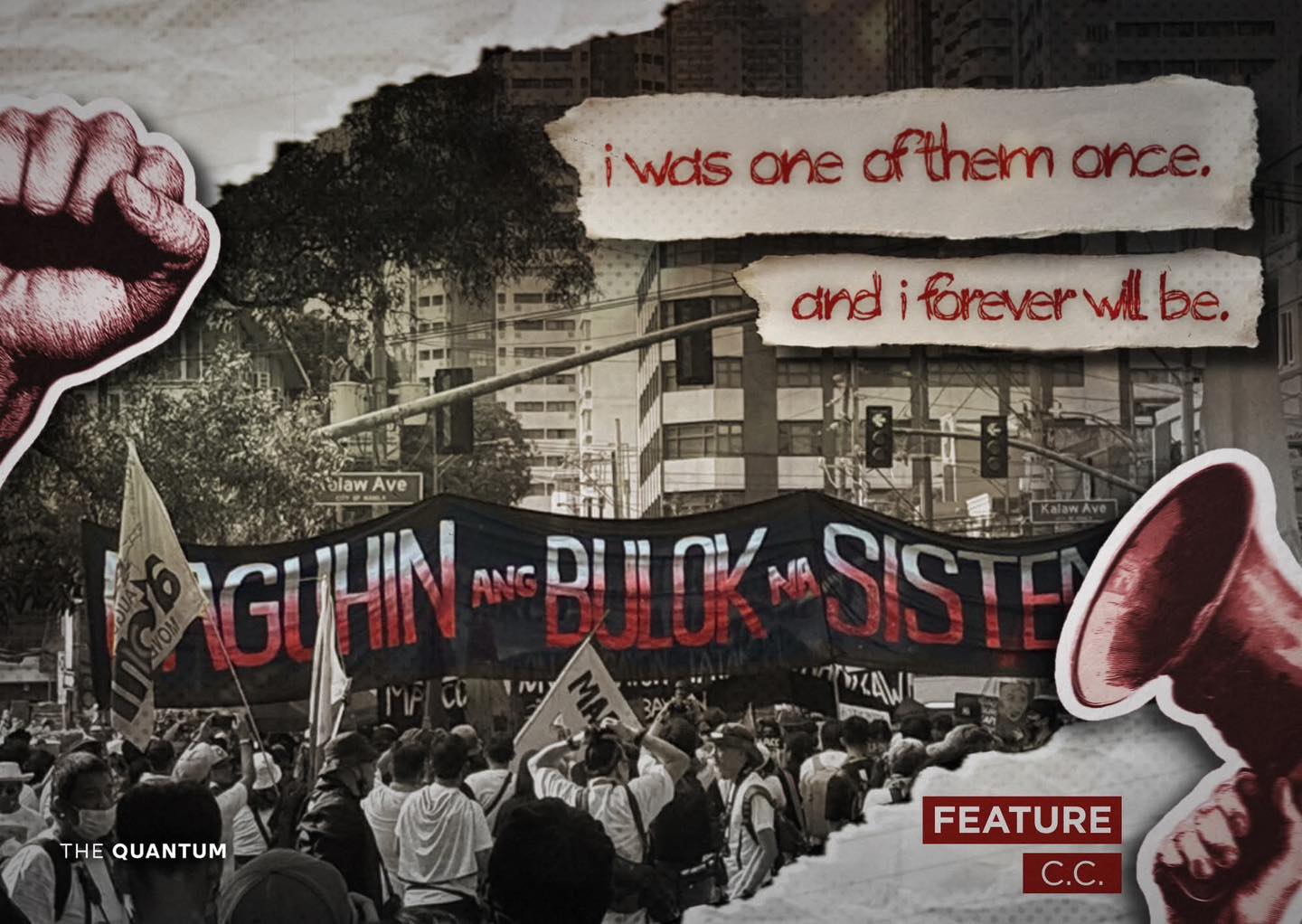
by: Chloe CristobalCopyedited by: Joebbie GauganoPublication by: Jamelle Ronquillo The streets are crowded, cultivated, and booming with cries of protests. They march with a proud stride that shakes the ground they step on. Their voices echo the pleas of every generation that’s witnessed injustice. Their signs make the roads like a sea of colors, each one representing a fervent desire for change. They didn’t just walk; with them, they carried the fury of the betrayed, the wishes of the unheard, and the dreams of the forsaken. Today, the city of Manila is not just protesting—it is remembering, demanding, and hoping. I was one of them once. But now, the weight of years lived weighs down my shoulders. The fire burning in my chest now causes my heart to ache. The hands I raised in protest now tremble with age—but not with fear. Never with fear. I watch from the window as they surge forward. Students, workers, artists, and elders walked side by side. People of different skin, backgrounds, orientations, and jobs held each other’s hands as they screamed and demanded. Their differences dissolved in the unity of purpose and passion. The atmosphere pulsed with phrases that refused to be ignored, each syllable a strike against suppression. And oh, how I longed to feel that relentless inferno in my chest once again. I was one of them once, and I wish I was marching with them right now. Though my heart relishes the fact that the spirit I carried still lives on. That the chants I used to shout are louder and bolder as they utter them. That the streets I walked with trembling hope are now filled with unwavering conviction. A conviction that’s lasted for decades because of corruption that has been persistent … the more I think about it. I cannot help but ask why the battle we fought is being passed on to the children we promised a better future. I was one of them once, and it breaks my heart to see that there is still a need for mass laments like these. The echoes of cries grow louder, but the people who sit atop remain unmoved and apathetic. The faces in the crowds differ, even multiply, but the pain they carry and show seems hauntingly familiar. The systems we fought to change seem to bounce back and grow even stronger, fueled by greed, nepotism, and indifference. Yet, even as these thoughts weigh heavy on my soul, as I look back out the window, I realize that I find solace in the march itself. In the rhythm of resistance. In the defiance they show. In the truth that every step taken today means something for the people. In the fact that every voice raised is one step closer to achieving change. I was one of them once, and I forever will be. I sit in my chair watching as the crowd slowly evaporates and heads on to the next corner. My heart burns with sorrow and pride, for as long as the battle persists, so does our spirit. And maybe this time around, their yells will reach even those who turn their backs to the sound.
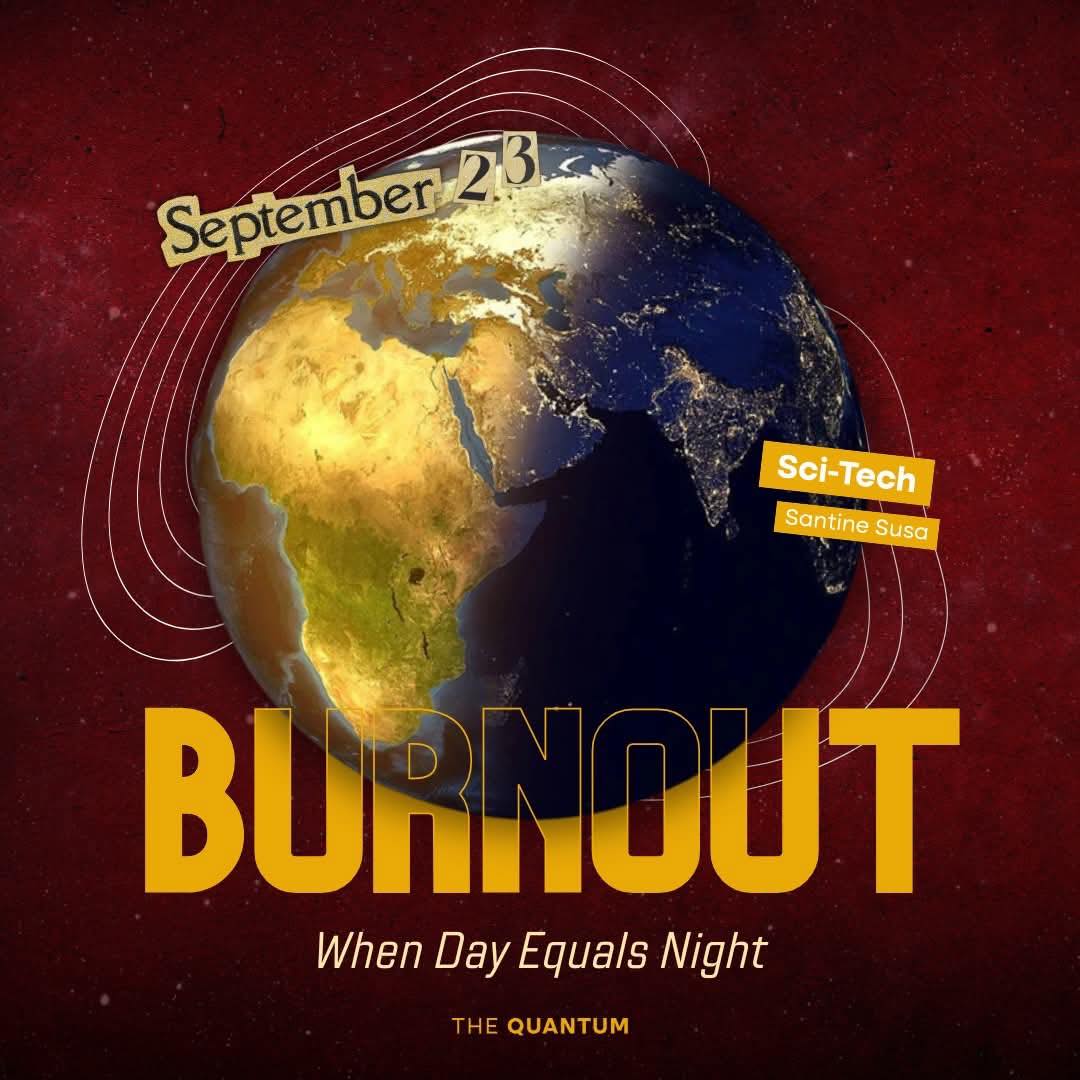
Burnout: When Day Equals Night
by: Santine SusaCopyedited by: Ayesha RonquilloPublication by: Yelena Fabricante On or around September 21-24, Earth experiences the September equinox, a moment when the Sun crosses the celestial equator heading southward. During this instant, day and night are nearly equal in length worldwide, hence the term equinox, Latin for “equal night.” In the Northern Hemisphere, it marks the start of astronomical autumn, while in the Southern Hemisphere it signals spring’s arrival. The balance of sunlight influences atmospheric circulation, ocean currents, and seasonal weather patterns. Farmers, navigators, and ancient civilizations once tracked the equinox to plan harvests and ceremonies, and modern astronomers still use it as a reference point in the sky’s coordinate system. The September equinox also offers opportunities for science outreach, amateur astronomers can observe the Sun’s position rising due east and setting due west, while climate scientists watch seasonal shifts in sea ice, monsoons, and animal migrations. The equinox is a reminder that, whether you’re gazing at the stars or checking your weather app, it is a silent, yet key driver of life on Earth.
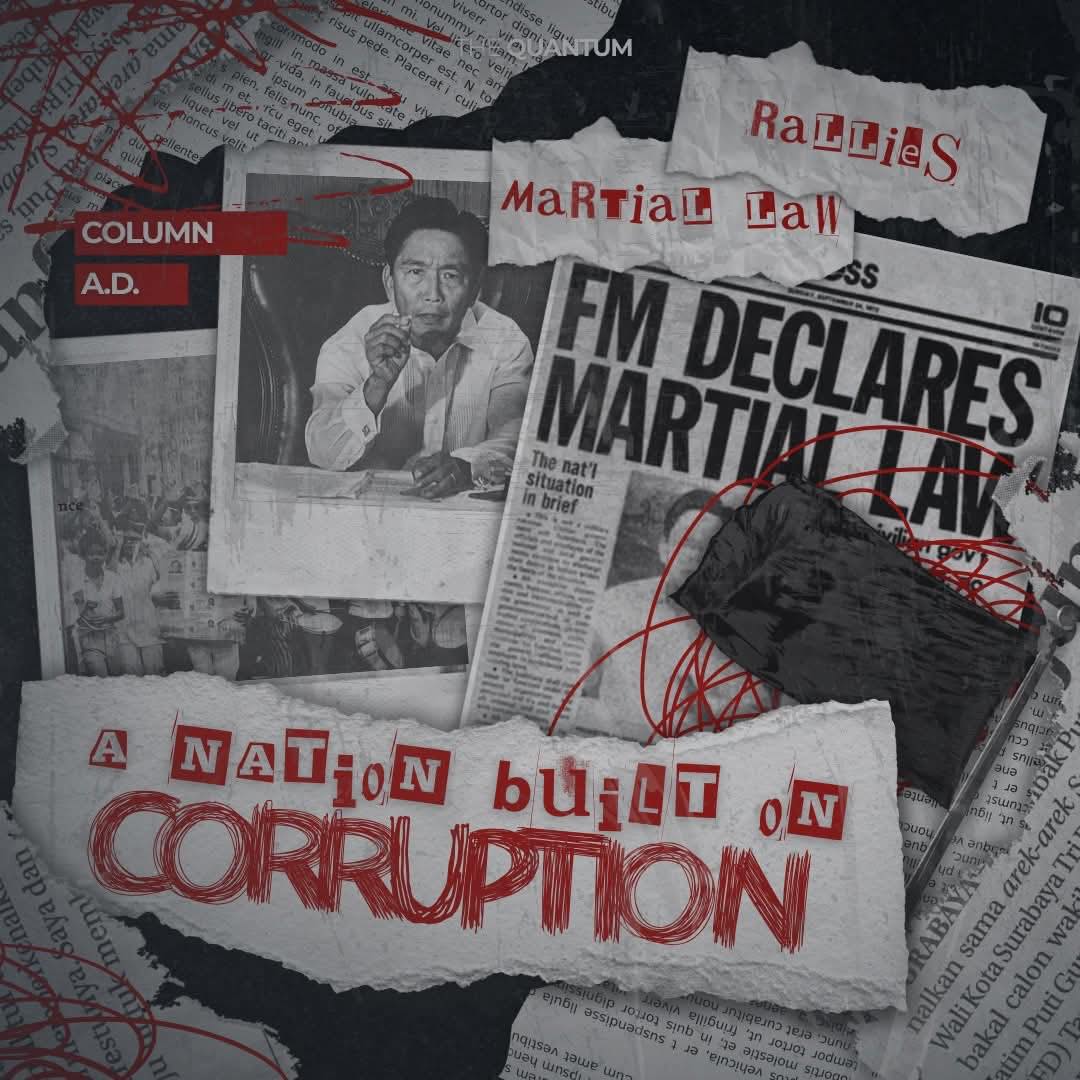
A nation built on corruption
by: A.D.Copyedited by: S.C.Publication by: P.B. Last Sunday, streets were flooded not by mementos of ghost projects, but by the imprints of hundreds of thousands of Filipinos who dared defy the corrupt. Placards may be put down, streamers may be folded away, and chants may slowly fade. But this time, the people will not relent. It is no coincidence that the nationwide protests occurred on the anniversary of Ferdinand Marcos Sr.’s proclamation of Martial Law 53 years ago—an era marked by censorship, abuse, historical revisionism, and the systemic dismantling of democracy. In fact, it was the perfect juncture to call out the brazen robbery of trillions and demand long-overdue accountability from the perpetrators. September 21 wasn’t just a famous remembrance, but a haunting reminder that the remnants of the past continue to scar the Filipinos. Corruption has always been a systemic issue. Not a recent trend, nor a political anomaly. It has been deeply entrenched in the field of governance, guarded by impunity, and has continued for decades that it might as well be an heirloom. Generations of corruption do more than just put wealth in a politician’s pocket. It erodes trust, impedes progress, and manipulates the masses to tolerate social injustices. No justification must save the regime from scrutiny. From lists of phantom projects, shady contractors, and nepo babies, to senate hearings of corrupt officials and echoes of a corrupt past—it’s as if the shameless betrayal of the public became the tipping point for the nationwide protest. When a nation has endured decades of outright theft, anger, distrust, and indignation inevitably take root—and are passed down to future generations. Youth inherit broken systems and are left to fix damages they didn’t cause. Because when the youth have their present stolen, they rise to fight for their future. And the streets heard them. Banners were raised, chants were echoed through every avenue, and rallies were led by compassionate youths, sectoral groups, and societal organizations. And fittingly, it all unfolded on the Martial Law anniversary. But this year, September 21 was no longer about lamenting the past; it’s about confronting the injustices of the present. The recent protest recounted that stolen past and cried out, “Never forget.” It stood against a myriad of grievances—ignorance towards agriculture, a flawed education system, and corruption, among many others—and they roared, “Never again.” Was this march finally a break in the pattern, or are we doomed to repeat the cycle of outrage and forgetting? Frankly, the answer relies on our volition to remain steadfast in demanding accountability and transparency. We deserve leaders who serve the people, not their own interests. We deserve better. When the noise finally fades, there is no one to sound the alarms but ourselves. What matters most isn’t the protest, it’s what happens after. To confront the issues without animosity is worthless. Outrage without persistence dies as noise. A nation built on corruption does not weaken—it only hardens its resolve. Their defiance and determination to punish the culprits must only grow stronger. And we, then, must carry this fire until every corner of our society is free from the grips of corruption. The recent march was a testament—a testament to the people’s anger, their resentment, and their desire for change. It was a powerful warning, impossible to ignore, meant for everyone to see. Our message is clear: Condemn them. Incarcerate them. And if that sounds threatening, it is—because the future of this nation depends on it.

Muling Paghinga
| Claire Domenden| Andrea Urbina Sa katahimikan ng gabi, mayroong isang tao na isinusulat ang isang mensahe na sana’y magiging huling alaala ng kaniyang munting buhay. Sa ilang buwang pakikipaglaban sa depresyon, naniwala siyang wala nang saysay ang bukas. Ngunit sa mismong sandaling iyon, isang mensahe mula sa kaibigan ang dumating na tila ba’y isang anghel na pumipigil upang mangyari ang isang trahedya. “Kumusta ka? Nandito lang ako.” Iilang salita lamang ngunit naging rason ito upang muling kumislap ang pag-asa na matagal nang nawala. Bunsod nito ang unti-unti niyang pagkatanto na hindi siya nag-iisa, na mayroong mga taong handang makinig at umalalay. Kalauna’y natutuhan niyang huminga muli, magpatingin, at tanggapin na ang kasalukuyang nararanasan ay hindi kahinaan bagkus ito’y bahagi ng isang laban na maaari niyang mapagtagumpayan. Sa paggunita ng National Suicide Prevention Month, dala niya ang aral na mahalaga ang mental health gaya ng ibang bahagi ng ating katawan. Higit sa lahat ay naramdaman niyang mayroong mga kamay na laging handang umalalay, at mga balikat na maaaring sandalan mula sa mga kaibigan at pamilya hanggang sa mga propesyonal. Kaya ngayon at sa mga susunod na bukas ay maalala sana natin na hindi masamang huminga at magpahinga.
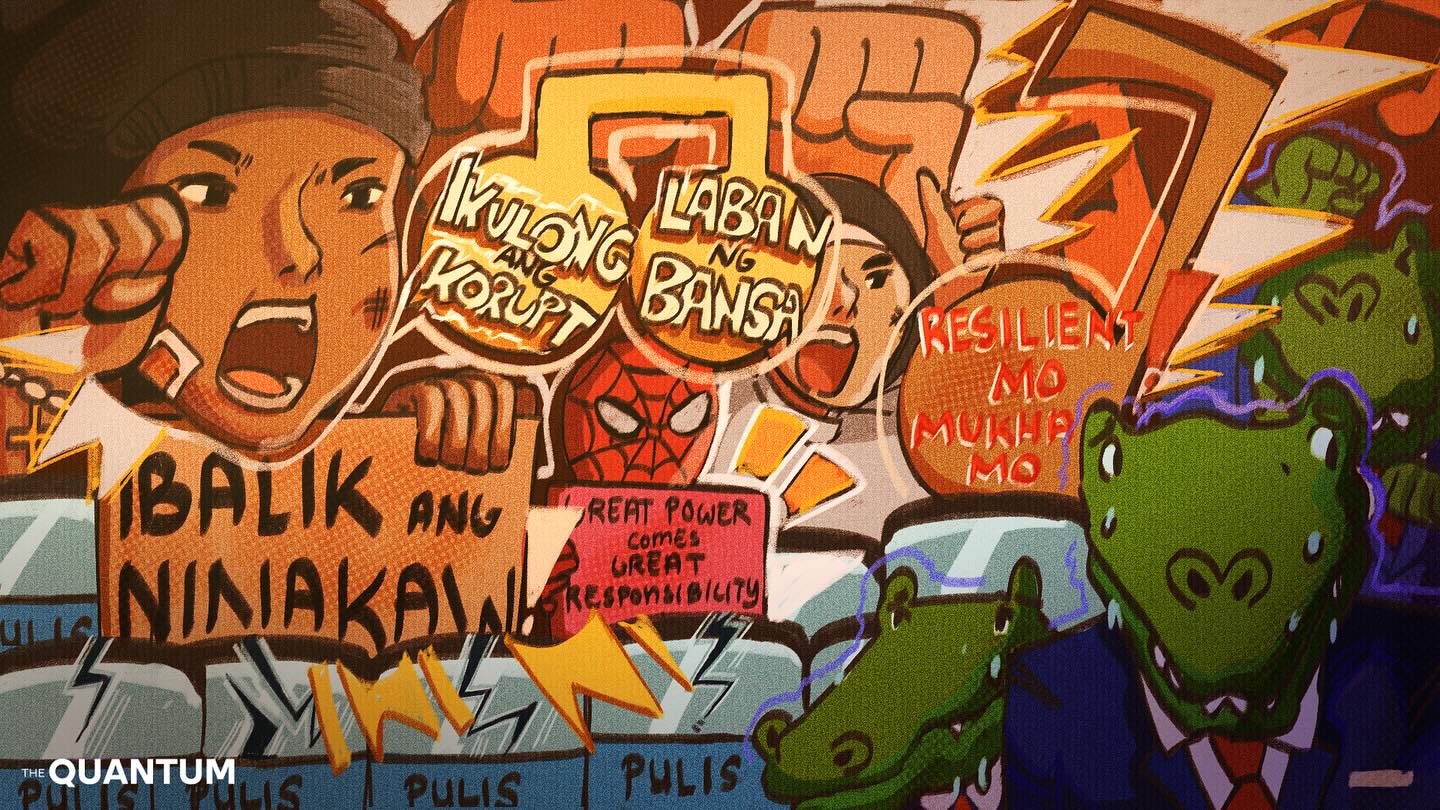
Song of Angry men
by: Rhian TabuadaCopyedited by: Jeyana Sophia CaparrosPublication by: Chesca Domondon Do you hear the people sing? The people who sing the song are the angry men who walk along the roads with posters and cardboards raised above their heads. Do you hear them? Do you hear me? Do you hear my people as we walk through neck-deep floods, our bodies soaked from head to toe with polluted water, leaving us dirty in mud as we make our way to our destination? Tell me—do you hear us? Or are you like them? The ones who cover their eyes, the ones who cover their ears, and the ones who cover their mouths. Do you also wash your hands, convincing yourself and those around you that what I experience is not your problem? Tell me. Or will you continue to remain oblivious? We have suffered for far too long. How about us? You who sit high and mighty in your golden throne, throwing scraps and pieces of whatever gold you spend, laughing away as you see us as pathetic and desperate as we chase after with what you can offer to give us. We have been in poverty for so long. We can only suffer in silence as you take everything until you are finished and full, your pig belly as wide as the piggy bank that you keep—inside is the money that should have been for the people. The money that should have been for the country, for the children, for the needy. I can only stare as I float through the muddy water, watching as you pass by with your precious chariot; your head up high as you only see what is at the top—the same thing that my people and I are chasing after. How long will you remain cruel? How long will we remain submerged in these waters, drowning and unheard, only the bubbles from our choked-out gasps surfacing? You pop our cries and watch as we drift lower down to our demise, yet you soar through the sky. I hope that you end up like Icarus. That soon your wax wings would burn, and you would suffer the same fate as us. In pain, drowning, and soon to be forgotten. May the masses utter the sentence of your crimes, that you shall be punished for your wrongdoings. My hands and my fellow men will eagerly accept your fall from grace, and we will drag you down with us.
Martial Law
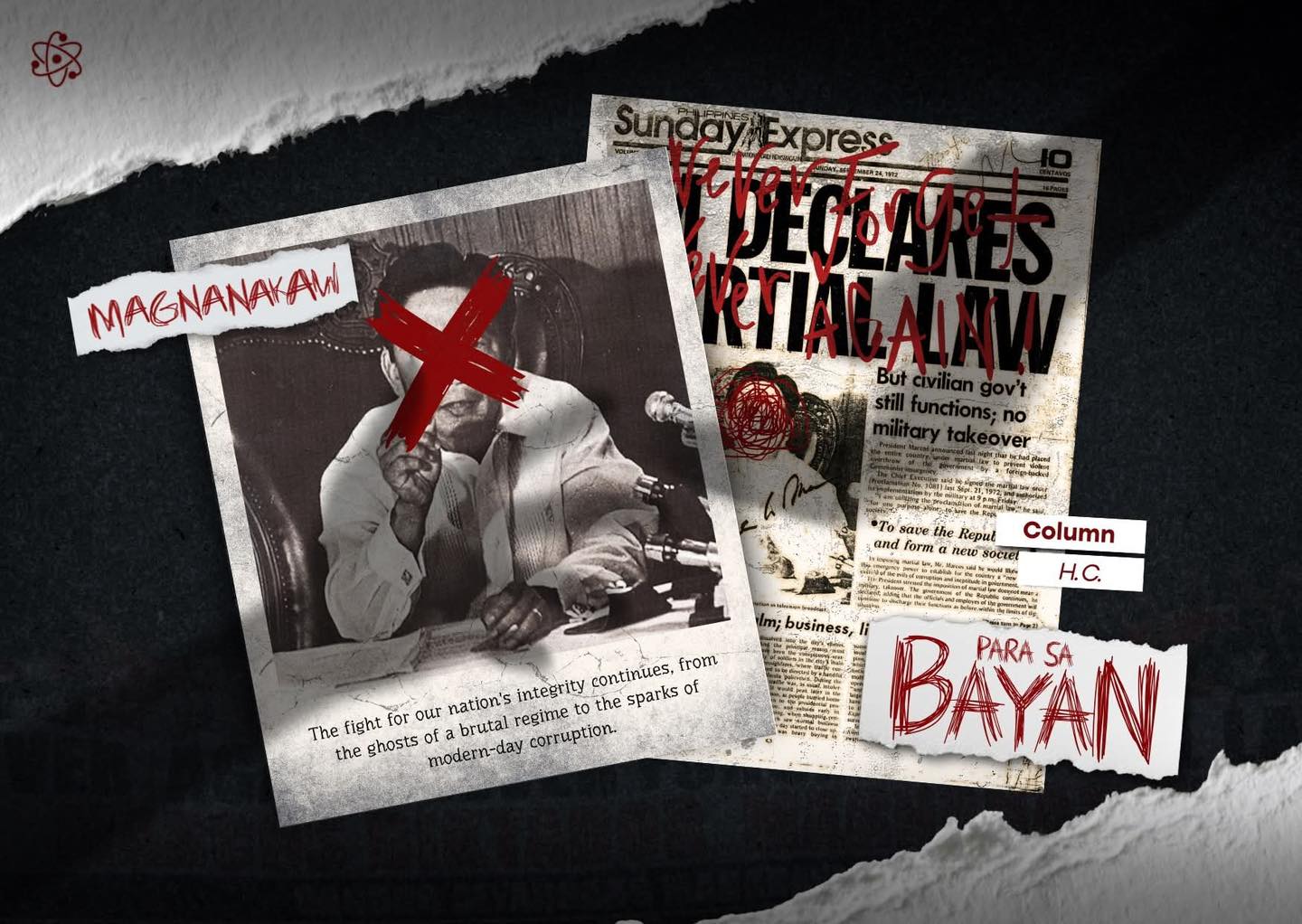
Today, we commemorate the 53rd anniversary of the declaration of Martial Law, a period marked by atrocities and killings that undermined the democracy and independence of the Filipino people. This chapter in our history serves as a reminder of the dangers of unchecked power and the suppression of dissent.Yet, the lessons of the past seem to be fading. A recent survey from WR Numero revealed that 56.5% of Filipinos view the Martial Law era positively, a testament to the developing historical revisionism that influences our nation. This statistic is not a phenomenon that is ignorable, but rather a starting point where new forms of injustice and rejectionism can grow. This year’s commemoration is not just about looking at our past but also reflecting on its ideals in our present. As investigations into flood control and other corruption allegations continue, we see the echoes of Martial Law’s abuse of authority through the rampant corruption in our government. While communities are submerged and lives are disrupted, billions of pesos meant for public welfare are allegedly absorbed into private pockets, a breach of commitment to Filipinos. In response, the Filipino public are once again taking to the streets and using social media to voice out the sentiments that those in power are trying to erase. Students have walked out of their classrooms, netizens use social media to call out public officials and their immediate families, and the whole populace, to the best of their ability, is protesting and demanding accountability. These demonstrations, set amidst the Martial Law anniversary, signify a renewed awakening and a refusal to be silenced. The fight for our nation’s integrity continues, from the ghosts of a brutal regime to the sparks of modern-day corruption. We, the students, stand at the forefront of this battle, armed with the memory of the past and the unwavering hope for a just future. We must not let history repeat itself through our ignorance or our silence. As always, Never forget. Never again.
When Stone Turns Against Us
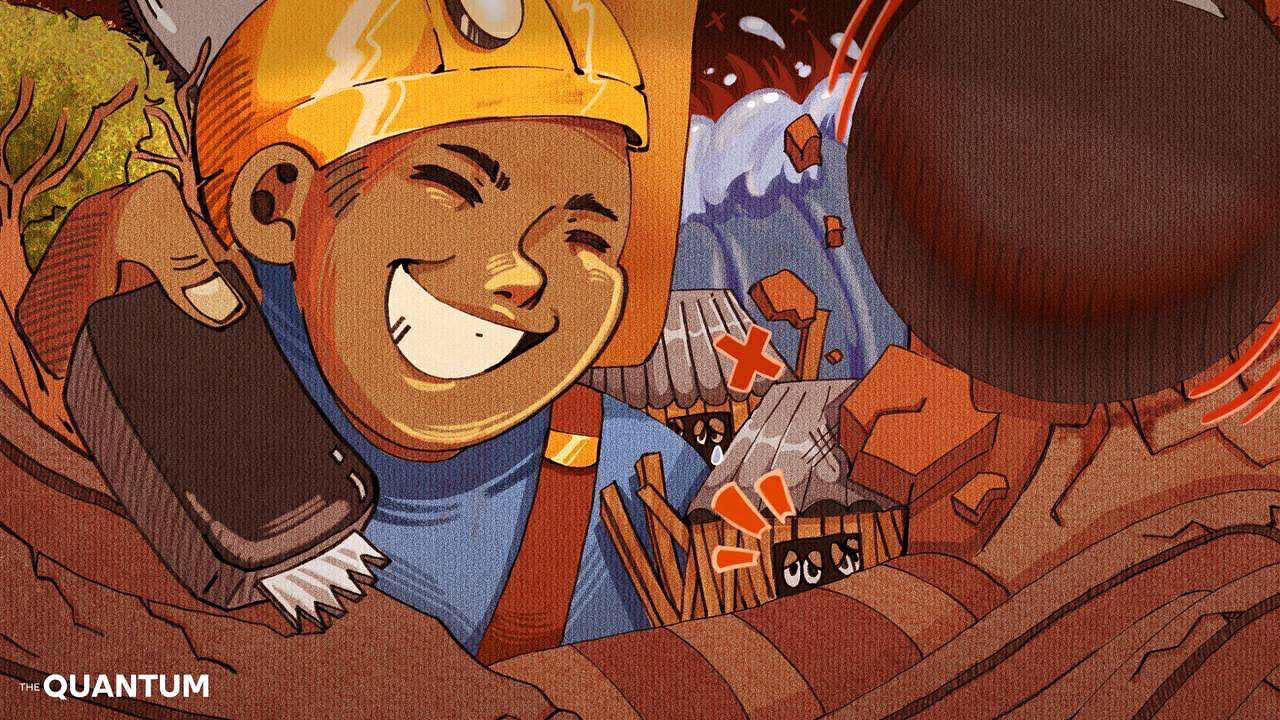
by: Santine Mauritius SusaCopyedited by: Orange AlcarazPublication by: Chesca Domondon When I look toward the hills of Angono, I remember when the gentle slopes—cresting into rich brown and dark green, used to be thick with trees that softened the rain and shielded the lowlands from floods. “The Sierra Madre is our protector,” as most of the elders say, recalling how storms once arrived with less fury. Now, with parts of the range carved away by quarrying to fuel urban development across Luzon, I noticed a stark difference: rivers swell faster, the ground stays waterlogged longer, and the floods feel deeper every year. For many in Barangay San Isidro, the quarry that has operated for nearly a decade is not just removing rock—it is chipping away at their last line of defense. The Sierra Madre mountain range has long been called the “backbone” of Luzon, acting as a natural shield that weakens typhoons before they reach the country’s population centers. In Rizal, the range’s foothills not only protect lives but also stabilize soil, regulate water flow, and host diverse ecosystems. Quarrying disrupts this balance. Vegetation loss and soil removal expose slopes to erosion, sending sediment into rivers and narrowing channels downstream. For the communities around San Isidro, these changes have turned typhoon season into a recurring threat, where heavy rains no longer just test resilience—they overwhelm the practice of it. Economically, quarrying remains a contentious trade-off. The industry provides jobs and supplies construction materials essential for urban growth. In Angono, trucks leaving the quarry feed the demand for gravel and stone in Metro Manila’s rapid expansion. Yet the short-term gains stand against long-term costs: repeated flood damage, declining farmland productivity, and increased spending on disaster recovery. For residents, the equation is simple but urgent—how much economic benefit justifies the degradation of natural defenses like the Sierra Madre? The political dimension complicates matters further. While local officials and residents have renewed calls for the quarry’s closure, authority over large-scale mining operations rests with the Department of Environment and Natural Resources. This means municipal leaders can lobby, pass resolutions, and amplify public pressure, but they cannot enforce a shutdown. The situation exposes the gap between community will and national policy, a gap often exploited by industries with economic clout and political connections. Internationally, the fight has gained a new legal framing. The recent International Court of Justice advisory opinion affirmed that climate-vulnerable nations like the Philippines have the right to seek reparations from major polluting countries. While the ruling does not directly halt quarrying in Angono, it strengthens the argument that local environmental harm is part of a global chain of accountability. It reframes the quarry dispute as not only a land-use issue, but also a test of climate justice—whether communities on the frontlines can demand both domestic and international action. Environmental scientists warn that losing even small segments of the Sierra Madre’s protective cover has cascading effects. Floodwaters that used to be slowed by dense vegetation now rush unhindered toward lowland cities. Sediment-laden rivers reduce water quality and increase maintenance costs for dams and reservoirs. Over time, these compounding impacts could make future typhoon damage both more frequent and more severe—turning what is now a local hazard into a national liability. As machines in Barangay San Isidro continue their work, the quarry stands as a crossroads between two futures: one where economic growth continues to be measured in truckloads of extracted stone, and another where the value of intact forests, stable slopes, and protected communities is placed higher on the ledger. Whether the Sierra Madre remains a living shield or becomes a memory, like the ones inhabitants near the range are clinging to, will depend on decisions made not only in Rizal, but in Manila’s halls of power—and perhaps, in the courtrooms of the world.

Nangangarap maging Iska
| Danica Wayne D. Araneta| Leigh Ann Prado Rebultong hubad—simbolo ng walang pag-aalinlangang pag-aalay ng sarili, ng sakripisyo, at tapat na paglilingkod para sa bayan. Numero unong unibersidad na matatagpuan sa Pilipinas. Hinahangaan, tinitingala at pinapangarap ng karamihan. Ang makapag-aral at higit sa lahat, makapagtapos dito, ay itinuturing na isang malaking tagumpay. Tagumpay na nagbibigay pag-asa at panibagong sigla sa sinumang nangangarap. Ngunit ano nga ba ang taglay ng Unibersidad ng Pilipinas at ito’y itinuturing na hangarin ng napakaraming kabataang Pilipino? “Mahirap makapasok d’yan!”, “Parang magsusuot ka sa butas ng karayom bago ka makapasa!”, ”Kapag nakapagtapos ka riyan, abot langit ang tuwang mararamdaman mo!” Iilan lamang ito sa mga komentong madalas kong naririnig. Sa bawat araw na puno ng pasanin mula sa mga pagsusulit, takdang-aralin, at iba pang gawaing pang-akademiko, hindi natin maiwasang itanong sa sarili: “Paano ko mararating ang unibersidad na kinikilala bilang sagisag ng tagumpay at oportunidad na matagal ko nang minimithi?” Ang Unibersidad ng Pilipinas ay hindi lamang basta – basta isang pampublikong paaralan. Isa itong kinatawan ng mga pangarap — mga pangarap na nangangailangan ng ‘di matatawarang dedikasyon, sakripisyo, at pagsisikap. Madalas, ang kaisipang ito ang nagsisilbing apoy na nagtutulak sa atin upang magpatuloy sa kabila ng pagod, puyat, at hirap. At ang laban na ito ay hindi lamang para sa ating mga sarili, kundi para rin sa mga taong patuloy na naniniwala sa atin, at sa ating mga kakayahan. Ang landas patungo sa UP ay hindi madaling tahakin. Puno ito ng mga pagsubok, pagdududa, at paulit-ulit na tanong kung sapat na ba ang ating ginagawa. Ilang oras na ba ang ginugol sa pag-aaral ng mga leksyong tila hindi maintindihan? Ilang gabi na bang tulog ang isinakripisyo, ilang kasayahan ang ipinagpaliban, at ilang beses na bang muntik nang sumuko? Ngunit sa kabila ng lahat ng ito, patuloy pa rin tayong naniniwala. Dahil alam nating ang bawat hirap ay may kahihinatnang ginhawa—isang mas maliwanag na kinabukasan hindi lang para sa atin, kundi para sa ating mga pamilya. Ang pagpasok sa UP ay hindi lamang usapin ng mataas na marka o katalinuhan. Ito ay higit na pagsubok ng tibay ng loob, determinasyon, at handang magsakrapisyo lampas pa sa inaakala ng iba. Sa bawat gabing pinipilit mong manatiling gising upang matapos ang mga gawain, sa bawat pagsubok na pilit mong nilalampasan, ipinapakita mo sa sarili mo na kaya mong abutin ang pangarap mo. Ang maging Iskolar ng Bayan. Ang pangarap na makapasok sa UP ay nagsisilbing ilaw sa madilim na daan. Isang inspirasyon sa ating mga puso upang hindi sumuko., Tinuturuan tayo ng pangarap na ito na ang tagumpay ay hindi nakakamtan sa isang iglap, kundi bunga ng pananalig, tiyaga, at pusong handang magsilbi sa lahat. Hanggang sa dumating ang araw na hawak mo na ang liham ng pagtanggap, hanggang sa maisuot mo na ang sablay na sagisag ng tagumpay, patuloy tayong mangangarap, magsusumikap, at maglilingkod sa nasasakupan. Dahil sa Unibersidad ng Pilipinas, ang bawat pangarap ay nagkakaroon ng layunin—ang maging tunay na alagad ng bayan.
Cashing Out Childhood
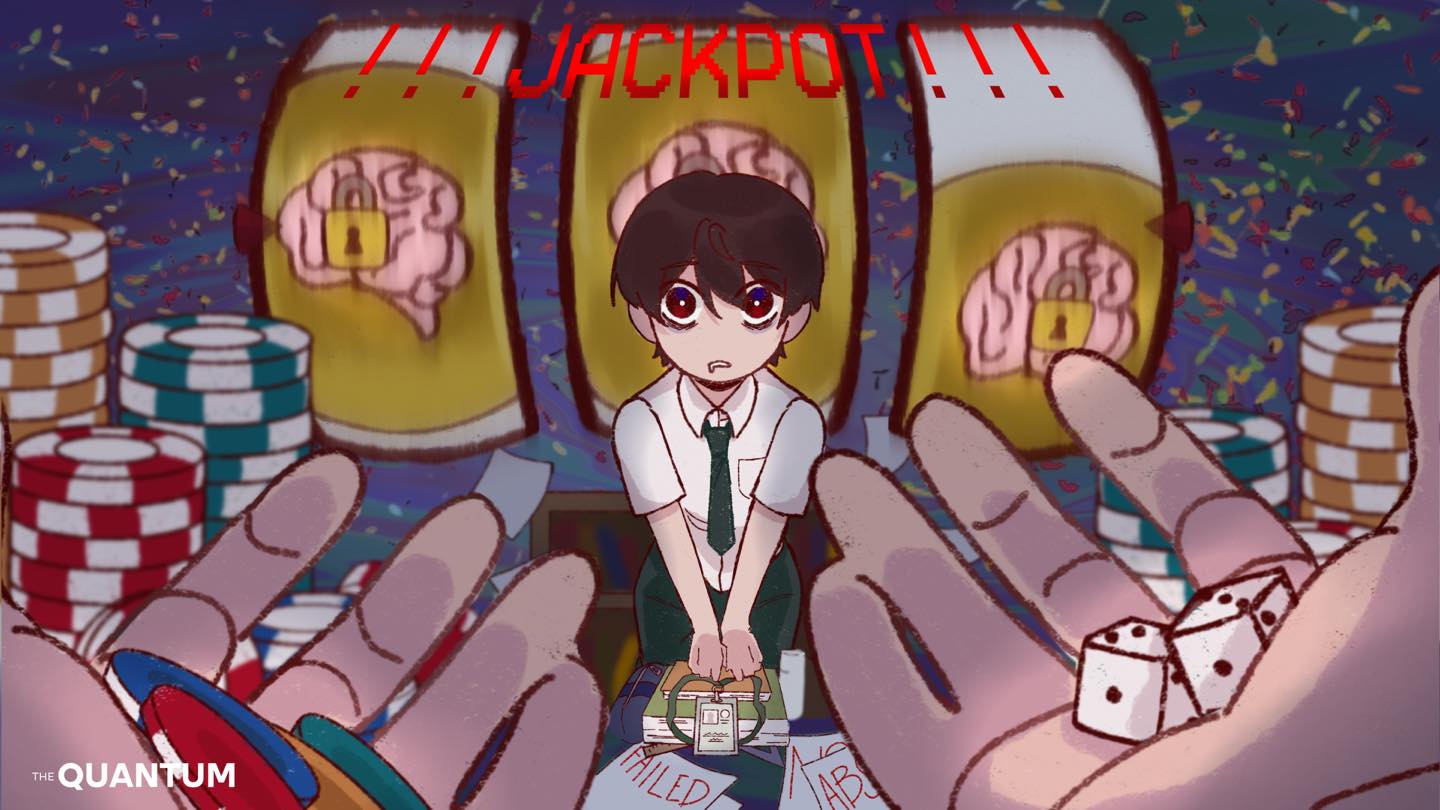
by: Henry Clark CabigonGraphics by: FreAnne Grace TenedorCopyedited by: Joebbie Gaugano When we are still children and even now as adolescents, we learn and develop, not by dictation but by experience. As the Swiss psychologist Jean Piaget says, “Play is the work of childhood,” reiterating that playing is not just a way for children to pass time or have fun but also their most important form of learning and development. But what if this play is not the conventional, traditional definition of playing with friends on the streets but rather on the dangerous abyss of online clicks, dice, and bets, which is online gambling? Currently, authorities are taking a step against this dangerous platform if unregulated. Government agencies like PAGCOR and lawmakers such as Senator Zubiri have filed bills to impose stricter regulations to shield minors from these predatory platforms. PAGCOR, on the other hand, orders the takedown of ads pushing gambling on billboards, aiming to eradicate its pushy and encouraging narratives. These efforts, blocking websites and demanding better age verification, are a crucial first line of defense. This digital form of gambling poses a more complex and unpredictable danger to young people today. Unlike physical casinos that have bouncers and stricter rules, online gambling is open around the clock and accessible from anywhere, including homes and public spaces, using only a smartphone. These sites, using creative graphics and exciting sound effects, are carefully made to appeal to young people, making it difficult to distinguish between real gambling and the mobile games we already enjoy. This transforms the idea of play from a fun, social activity into a lonely, high-stakes obsession that removes the value of patience and hard work, replacing them with the lie of easy money. These then turn into debt, failing grades, anxiety, and a diminished pathway to a better future. However, this is not a problem the government can solve alone. The internet is vast, and for every illegal site that is taken down, another can rise almost instantly. The fight against online gambling cannot just be won in Congress; it must also be taught in our homes and classrooms. The ultimate defense against this digital threat requires a united effort from all of us. For parents, it means having open, honest conversations about the real dangers hiding behind these screens and being aware of their children’s online activities. For our schools, it means integrating digital and financial literacy into the instruction, teaching students how to see past the marketing gimmicks and understand the consequences when we try to play with online gambling. And for us, the youth, it means being vigilant protectors of our own well-being and that of our friends, because if we don’t take a stand now, we may be gambling away not just money, but our very future.
Bridging Borders: Philippines-Japan Friendship Day
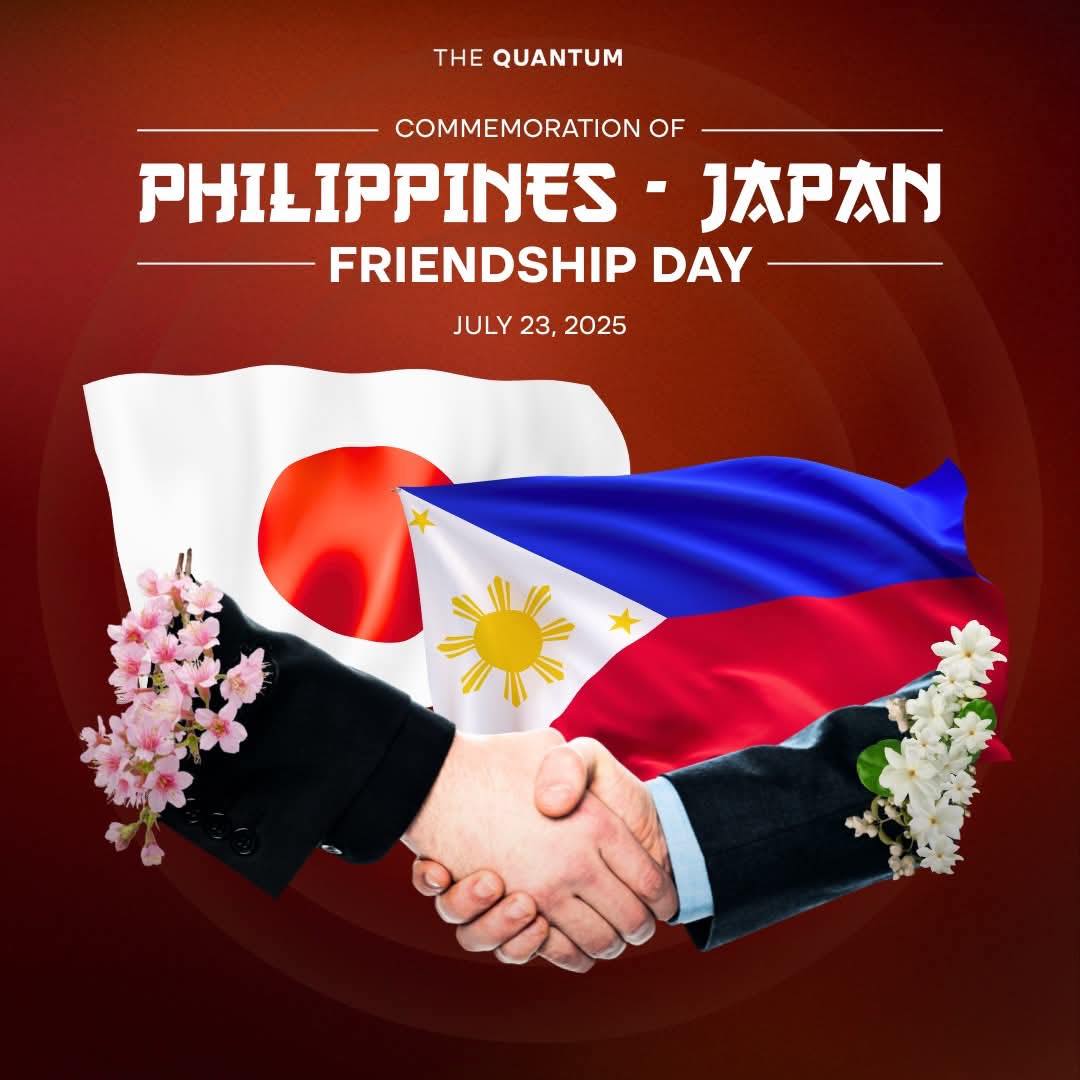
by: Danella De Vera Copyedited by: Carlos Agripa Publication by: Yelena Fabricante Association is one thing; amity is another. Aligning is one thing; intertwining is another. Yesterday, July 23, marked the 69th year celebration of a significant partnership—a friendship that tied knots and raveled unfinished history, one that transcended borders, bonded in culture, and paved the way for peace. Almost seven decades ago, the diplomatic relations between the Philippines and Japan were formalized through the signing of the Peace Treaty and Reparations Agreement on July 23, 1956. Consequently, to recognize the celebration of the 50th anniversary of the nations’ relations, President Gloria Macapagal Arroyo declared July 23 as the official Philippines-Japan Friendship Day and 2006 as the Philippines-Japan Friendship Year through Proclamation 854 s. 2005 and Proclamation 905 s. 2005, respectively. Enriching this friendship through frequent gatherings and affiliations, the Philippines and Japan have accomplished several notable projects: Transport and Infrastructure Development Under Japan’s first cooperation pillar of ‘Strengthening a Foundation for Sustainable Economic Growth’ railway developments in Metro Manila were implemented. Under this is the ongoing provision of financial and technical support in the Metro Manila Subway project and the rehabilitation and modernization of the Metro Rail Transit (MRT) Line 3. Equipped with Japan’s advanced technology, these projects aim to accommodate the increasing demand in transportation and to aid traffic congestion and issues of frequent malfunction. Along with this, Japan has also been involved in several road and bridge projects around the Philippines, including the Davao City Bypass, the Cebu-Mactan 4th Bridge, and the San Juanico Bridge. Life Protection and Capacity Development Japan has also taken part in assistance to several healthcare, medical, and hygiene services in the country. This includes advanced medical equipment, infectious disease control, vaccination facilitation, and social rehabilitation. Moreover, to ensure the increase of opportunities and to recognize potentials, Japan has provided aid in education, including the funding for construction of schools and facilities, academic scholarships, and exchange student and teacher programs. Through several partnerships, Japan has also provided job opportunities in the country under the automotive, high-tech, electricity, and chemicals sectors in the Philippines. Contributions to Peace and Stability In the pursuit of peace and solitude, after years of conflict, Japan has implemented a wide range of assistance in the consolidation of peace in Mindanao, particularly the reconstruction of Marawi City after armed conflict in 2017. Training assistance to the Philippine Coast Guard and advanced armaments to the Philippine National Police were also provided to strengthen law enforcement and capabilities, proving that Japan stands with the Filipino people and is ready to assist the country to safety. The Philippines-Japan partnership proves a partnership that is built not only on mutual goals but on a profound sense of solidarity. This bond serves as a bridge between borders of culture and technology. And just like human-to-human friendships, the relationship between nations can stand the test of time, reminding us that in the face of challenges, company matters. References: The Modernization and Extension of Light Rail Transit Line 1 (LRT-1). Embassy of Japan in the Philippines, https://www.ph.emb-japan.go.jp/files/100816860.pdf. Accessed 24 July 2025. �Japan’s Official Development Assistance (ODA) to the Philippines. Ministry of Foreign Affairs of Japan, https://www.mofa.go.jp/files/100217186.pdf. Accessed 24 July 2025. �”The Philippines and Japan Celebrate 69 Strong Years of Friendship.” The Manila Times, 23 July 2025, https://www.manilatimes.net/…/the…/2153637/amp. Accessed 24 July 2025.