


Patnugot ni Angelique Inlong Ang kanilang mga aral ang nagsisilbing liwanag para sa ating kinabukasan. Sa pagtayo sa ating harapan, nagawa nilang maging gabay sa landas ng pagkatuto at tanglaw ng ating mga pangarap at tagumpay. Sa kanila, natutunan nating harapin ang mga hamon ng buhay nang may tapang at determinasyon. Sa pagdiriwang ng Buwan ng mga Guro, taos-puso nating pasalamatan ang kanilang dedikasyon at sakripisyo. Sa kabila ng bigat ng kanilang responsibilidad, patuloy silang nagsisilbing haligi ng pag-asa at inspirasyon para sa bawat mag-aaral. Maligayang Buwan ng mga Guro mula sa Ang Liwanag!

Mpox is making headlines—are you fully aware?
By: Carl Niño Carasco Publication: Jamelle Ronquillo Get a concise overview of the latest information, essential precautions, and what you need to stay informed and safe. Read The Quantum’s short primer to understand the current situation and protect yourself and your community.

National Crime Prevention Week: How Students from Pasay City National Science High School Can Contribute
by: Mark Anthony F. Familaran This year, law enforcement agencies headed by the National Police Commission (NAPOLCOM) scheduled a weeklong event, Sept.2-6, 2024 where the focus was mainly on community involvement–including students–in crime prevention. To increase people’s awareness of illegal activities and make it possible for community organizations to have more methods of keeping the public safe, the Philippines celebrates National Crime Prevention Week yearly. At Pasay City National Science High School (PCNSciHS) this is a rare opportunity for students to learn, take part in activities, and contribute to making their own school and neighborhood a safer environment. What is National Crime Prevention Week then? NCPW is an opportunity for citizens and government officials to learn about various methods of crime prevention and to put into practice new ways to create a safer future. This year’s NCPW awareness campaign departs from the traditional by looking at how communities (including students) help govern police forces on behalf of authorities. For the students, it’s vital to teach them about crime prevention where altogether they contribute to a culture of safety that bans crime and saves lives. Students, How Can You Keep Crime from Happening? Education and Awareness: Different people will find different information helpful. Thus, it is important for students to have a basic understanding of the kinds of crimes most likely happening in their society. Among them are crime related to drugs, violence, theft, and cybercrime. As soon as they are aware of these hazards, students can take actions to avoid them happening to them and they can pass this on to their classmates too. Students can learn from National Crime Prevention Week programs with local police and judicial personnel, or those given by the schools. This includes issues such as crime tactics, self-defense methods, and the importance of reporting offenses. Establishing a safe school atmosphere: Moreover, students themselves have the power to promote and maintain the school’s atmosphere of security and mutual respect. In practice it means always being vigilant and reporting anything out of the ordinary or dangerous. To heighten the awareness of their student body in this respect, it is another method to set up student organizations concerned with security and safety. One way that groups can emphasize crime prevention is through activities like poster contests, slogan making contests, or even very short plays to participate in. Participating in community initiatives: Students take an active part in community-based measures aimed at crime prevention. Via police departments and NGOs, and with the help of local barangays, students learn firsthand about the safety concerns of a particular community. Then they try to develop solutions with community residents themselves. In addition to giving people a sense of ownership in their surroundings, joining neighborhood watches, participating in community patrols serves the purpose of making everything safer. Cybercrime awareness and digital responsibility: In this era of digital modernity, people are still harboring old ideas and beliefs. Each student must understand the dangers that this poses for them. Some of these are cyberbullying, identity theft, online fraud and the like. So that people will be encouraged to integrate themselves well into society, teachers need to give students a proper sense of social decorum and safe treading ground on social media like Facebook that shares new resources as its posts. Promotion and advocacy by student leaders: On platforms provided by students, the leaders themselves may well serve as promotional outlets for crime prevention. They can arrange their own talks with articulated organizations and prepare and supply auxiliary materials as well. Engaging in School Drills and Safety Instructions Active participation in safety drills, such as fire, earthquake, and lockdown drills or any kind of emergency. Individual participation is needed for everyone to know how to react should it really become an emergency. What Students Should Know In An Emergency, Who Can Be Called: Find out the contact information of the local police, fire brigade and ambulance services. Environmental Awareness: When we take notice of our surroundings, we’ll prevent accidents/crimes. Living Within the Law: By paying attention to local regulations and conventions of proper behavior, students can avoid actions that could have negative legal consequences. Foster a Sense of Community: Crime prevention is not just the responsibility of law enforcement; it is a community effort. The elements are all there. Friends, next of kin, neighbors. They should all support one another and work together to fight against a common enemy. The students at Pasay City National Science High School will have the opportunity during National Crime Prevention Week to learn about security and community involvement, to inculcate within them a sense of their responsibilities and obligations to this society. If only all students simply look, hold themselves to account and involve in the life of the community, a culture of co-operation and vigilance in society vacuum will certainly arise.

“Smog? Vog? Ano ba talaga?”
By: Kandice Anne Paras Publication: Cassandra Fallena Do you need a recap on last week’s Smog-Vog Phenomenon that hit Southern Luzon and Metro Manila? Learn the essentials to keep yourself and your community safe from Taal Volcano’s vog and Metro Manila’s hazy smog. Read The Quantum’s short primer on the situation.
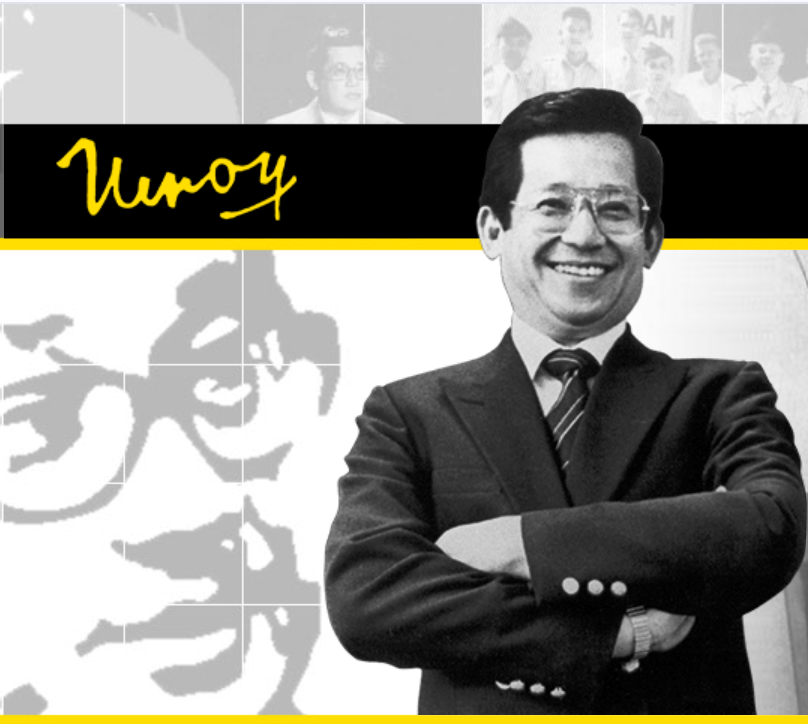
The Legacy of Ninoy Aquino: A Day of Reflection and National Pride
By: Ruwena D. Cascayan- Teacher II Picture taken from https://ninoyaquino.ph/ Today marks the Ninoy Aquino Day a significant observance in the Philippines, commemorated every August 21st. It honors the memory of Senator Benigno “Ninoy” Aquino Jr., a prominent figure in the country’s history and a martyr for democracy. Ninoy Aquino was a committed critic of the Marcos regime, which ruled the Philippines under martial law for much of the 1970s and 1980s. His outspokenness and dedication to the cause of democracy made him a target of the administration, leading to his imprisonment and eventual exile to the United States. Despite the dangers, Aquino decided to return to the Philippines in 1983 to continue his struggle for freedom and reform. On August 21, 1983, Ninoy Aquino was assassinated upon his arrival at the Manila International Airport (now named Ninoy Aquino International Airport in his honor). His death was a pivotal moment in Philippine history, sparking widespread outrage and stimulating opposition to the Marcos dictatorship. The event is often credited as the catalyst for the People Power Revolution of 1986, which eventually led to the downfall of Ferdinand Marcos and the restoration of democracy in the Philippines. On this day is a national non-working holiday in the Philippines, as established by Republic Act No. 9256, signed into law by President Gloria Macapagal-Arroyo in 2004. The day is marked by various ceremonies and activities that honor Ninoy’s legacy and his role in the struggle for democracy. Typically, the day includes wreath-laying ceremonies at the Ninoy Aquino monument in Manila, special Masses, and educational activities that aim to raise awareness about Aquino’s life and the importance of upholding democratic principles. Schools, civic organizations, and government institutions often hold programs highlighting the day’s significance and encouraging reflection on the sacrifices made by those who fought for the country’s freedom. His legacy continues to inspire generations of Filipinos. His famous words, “The Filipino is worth dying for,” have become a rallying cry for those who champion democracy, human rights, and social justice. The observance of Ninoy Aquino Day serves as a reminder of the importance of vigilance in safeguarding the freedoms and rights that were hard-won through the sacrifices of people like Aquino. The impact of Ninoy’s death also had a profound effect on his family. His wife, Corazon “Cory” Aquino, would later become the first female President of the Philippines, leading the country during a period of significant political and social transition. Their son, Benigno “Noynoy” Aquino III, also served as President from 2010 to 2016, continuing the family’s legacy of public service. Ninoy Aquino Day is not just a day of remembrance, but a call to action for all Filipinos to remain committed to the democratic ideals that Aquino fought for. It is a day to reflect on the nation’s history, honor those who have contributed to its progress, and ensure that the lessons of the past continue to guide the future. Recently, President Ferdinand R. Marcos Jr. issued Proclamation No. 665, moving the observance of Ninoy Aquino Day from Wednesday, August 21, 2024, to Friday, August 23, 2024, to boost domestic tourism in the country. The proclamation, signed by Executive Secretary Lucas Bersamin on August 15, 2024, aims to extend the weekend and encourage local travel while ensuring that the historical significance of Ninoy Aquino Day remains honored.

The Quantum: A Journey Through the Years
By: Rhian Tabuada and Amiel Gonzaga Copyedited by: Stacie Marie Catallo Publication: Rianne Dane Lopez and Ysabel Tagon The Quantum has always been a pivotal organization for the PaScian community, becoming a watchdog to disseminate information to the student body with accountability. This publication has an indisputable impact on the campus, becoming a pillar for many by imparting truth beyond just the headlines. With its various categories, including multimedia outputs ranging from literary, feature, news, column, sci-tech, and sports sections, to graphics, layouts, photojournalism, and broadcasting. The Quantum features a wide array of coverage on different topics, which allows an outlet of expression for campus journalists. It has become more than just a publication; it is a harbor for the many writers in the school who push beyond the status quo as well. For many years, TQ provided and continues to provide for the needs of those with a thirst for the truth. But, how did it all start? In the year 2002, Pasay City National Science High School was founded, marking a significant milestone, and initiating the school’s English-language newspaper publication. Ms. Rose Talladen, a retired DepEd teacher who once became a teacher in Pasay City National Science High School, was entrusted with the task of becoming the first adviser of the organization. However, after 3 years, Ms. Talladen was transferred to a different school, which called for the time to give the position to another teacher. Ms. Jackyline Lagana, who was assigned to teach the former students and graduates of PCNatSciHS 2005, found herself picking up the legacy that was left behind by Ms. Talladen, earning herself the title of The Quantum’s adviser, and one of the founding pillars for the organization. For more than 15 years, she became a steadfast mentor for the various Editors-in-Chief, officers, and writers, and became the hand that pushed her students to leave their unique markings and legacy within the walls of the organization. “To mention a few, the times when we competed in the NSPC for 3 straight years, though we didn’t clinch a spot, those experiences contributed a lot to my journey as a trainer in journalism and as a school paper adviser,” Ms. Lagana said when being asked about her time as the school paper’s adviser. For three consecutive years, from 2007 to 2010, Iza Darlene Cay, a notable alumni now working with GMA News, became the Editor-in-Chief of The Quantum during her second year to fourth year in high school. In 2019, Ms. Lagana decided to give up being a school paper adviser, saying she would be focusing on the Korean Language and other matters. She recommended another faculty member to take her place after leaving the organization. Mr. Mark Reniel Balolo became the newest adviser for The Quantum. He is a graduate of Philippine Normal University – Manila, with a Bachelor of Secondary Education major in Speech and Theater Arts. He also studied at De La Salle University – Manila having a Master of Arts in Communication major in Media Studies. Up to this day, he continues to serve as The Quantum’s adviser. Around this time, Iris Ivy Samson, a sports writer in the organization, was the Editor-in-Chief of TQ. Along with Dave Matthew Gerobin, they brought the school multiple accomplishments throughout their time in the publication by continuously receiving awards at school press conferences and competitions and competing in the National Schools Press Conference. During their leadership, several members of The Quantum were elected to positions in the Pasay City, National Capital Region, and National Secondary Editors Guild. Dave Matthew Gerobin inherited the position of becoming the next Editor-in-Chief. His journey to becoming a known EIC wasn’t blunt, Dave started as a Filipino Radio Broadcaster, soon becoming an Associate Editor for Ang Liwanag, the Filipino school newspaper publication. He proves his capabilities, which in turn leads to him being appointed to the position. He also served as the President for both Pasay City and NCR Secondary Editors’ Guild. “The path of a journalist, especially as a campus journalist, is often challenging but incredibly rewarding. Continue doing your work with passion and conviction, always remembering the reason why you chose this path and for whom you’re doing it… There will always be challenges but we need to learn to embrace these challenges for they are opportunities for growth,” Mr. Gerobin stated. The Quantum’s Social Media era kicked off through the insistence of Mr. Gerobin. They discovered that there hadn’t been a proper handover process of the already existing page. With the help of Mr. Balolo, they were able to kick off a fresh page of Quantum’s Facebook site, which allowed them to align their vision with their publication. With the pandemic confining the campus to their homes, the online presence on the Facebook page became the priority for output and disseminating information. However, even learners have to meet the end of their journey. Gerobin’s days at Pasay City National Science High School finally came to a close. However, his legacy didn’t end there — his history as a journalist didn’t die down. His tasks were shouldered to Gillian Gamboa, his Associate Editor and a Sports Writer for The Quantum. During the same year, the Quantum and the Liwanag scribes were awarded the Overall Best Performing School during the 40th Pasay City Secondary School’s Press Conference (PCSSPC) held last September 7, 2019, at Jose Rizal Elementary School. Among those winners were Ms. Gamboa, who placed 1st in Sports Writing, and Mr. Gerobin, who ranked as Best Sportscaster in Radio Broadcasting-Filipino. On October 19, 2019, the selected campus scribes of Pasay City National Science High School represented the school with honor and pride in the following Regional Schools Press Conference and Contest. However, the legacy of the Quantum did not end in 2019. Nay, it continued to flourish as the members continued to bring back home accomplishments, etching their names in the hall of fame; just like Ms. Gamboa, who, even as her antecedent leaves the school to continue reading : The Quantum: A Journey Through the Years
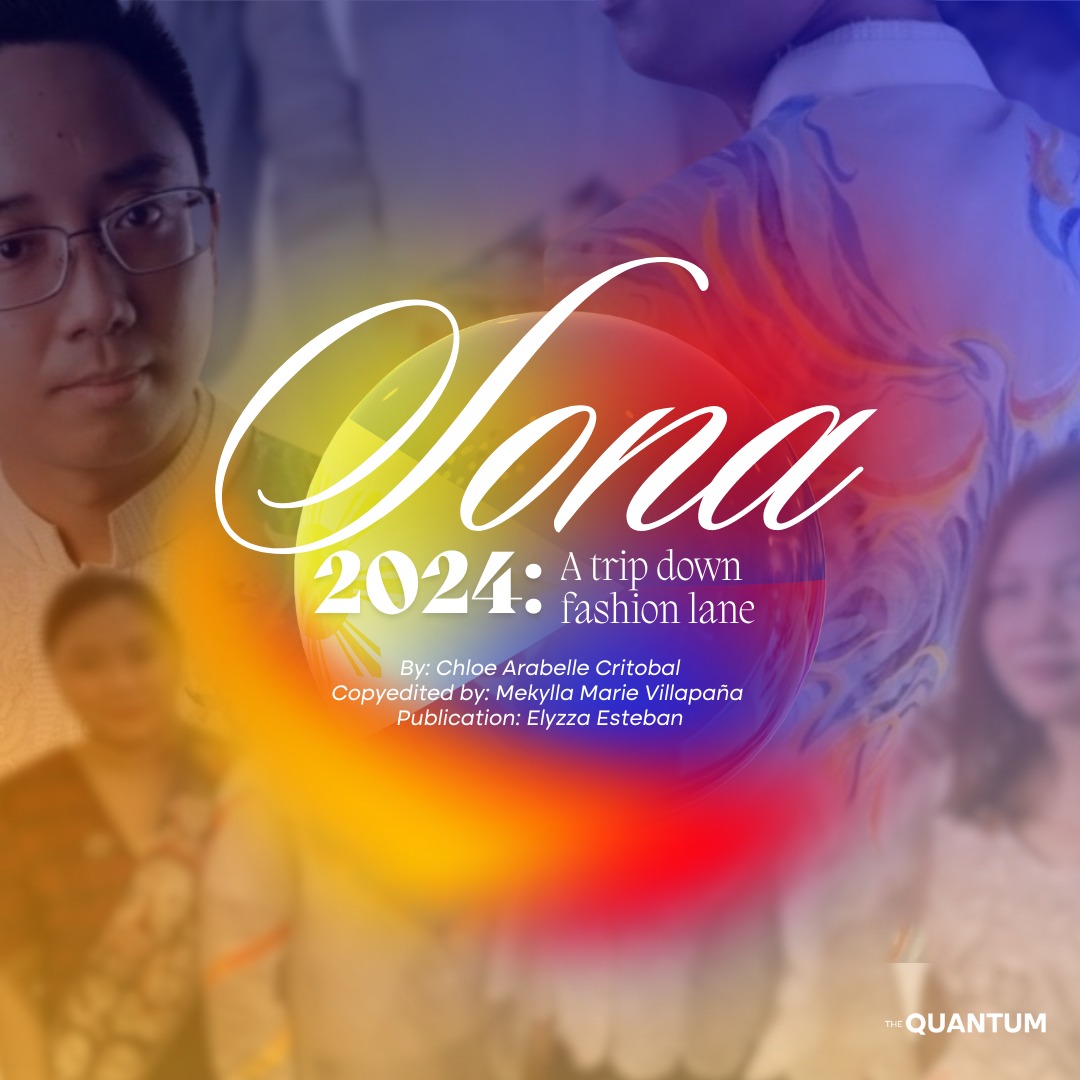
SONA 2024: A Trip Down Fashion Lane
By: Chloe Arabella Cristobal | Copyedited by: Mekylla Marie Villapaña | Publication: Elyzza Esteban Fashion is a word that holds a lot of meaning for many different people. It’s also one of those words that can be characterized in many unique ways. Some may describe it as a collection of the latest clothing trends you see on social media, or a personal wardrobe that you think fits your style the most. Although, at its very core, fashion is defined as a way of dressing or behaving in a particular time and place. From bold colors and loud prints to muted shades and intricate designs, one’s choice of clothing has never failed to let us catch a glimpse of the personality wearing the garments. Clothing serves to cover bareness, but in doing this, a person’s heritage, culture, and history may be laid bare for us to witness. The utter volume at which fashion speaks through its design is the reason why it does not only provide the runway statement pieces, it can also provide the public with important political statements that are relevant to our time. Regardless of this notion, on July 10, 2024, House Secretary General Reginald Velasco announced that guests wearing outfits with political statements or derogatory words will be banned from attending President Ferdinand Marcos Jr.’s State of the Nation Address (SONA) on July 22. As I heard the news, I thought back to the countless activists and politicians that wore these issues on their sleeves, literally. Over the years, multiple personalities have sported outfits related to often unaddressed political problems to the government-sanctioned event to shed light on these rudimentary issues. In the 2022 SONA, the Kabataan Partylist stunned the attendees with a special Barong Filipino worn by Kabataan Rep. Raoul Manuel. The initial sketch was made by student-artist Albert Raqueño, who turned the Barong Filipino into a canvas for a mural painting that showed the need for unity and social progress. On the back, there is a phoenix that symbolizes the struggles that each generation goes through to achieve this change, yet the continuous flow of the painting emphasizes the everlasting hope and optimism of the youth. Similarly, in last year’s SONA, Gabriela Women’s Partylist Rep. Arlene Brosas graced the red carpet with a top designed with stunning rose gold embroidery and a bottom half painted with imagery portraying opposition towards the Maharlika Investment Fund. This Filipiniana was designed by art teacher and activist, Michael Joselo. On the same carpet, ACT Teachers Partylist Rep. France Castro wore statement attire that pleaded for salary increases for teachers, nurses, and government workers. The skirt was painted with images of underpaid workers’ struggle as they try to navigate through their journeys despite this setback. It was also decorated with red and blue arrows pointing upwards signifying the need for salary increases. This was also designed by fellow educator, Joselo. The last stop in our trip down memory lane is the political SONA wear of Bayan Muna Rep. Carlos Zarate. In particular, his Barong Filipino designed by Atty. Ma. Sol Taule that was painted with depictions of Filipino Fishermen declaring sovereignty in the West Philippine Sea over China. In 2019, when tension was at an all-time high because of China’s belligerent presence in Philippine waters, his attire sent a needed reminder that we needed to fight for what is ours. These are only some of the many instances that have shown how fashion can function as a reflection of our time and a prompt of our past. Moreover, it can also serve as a hallmark that shows the progress we have made since these issues have risen. In modern times, fashion is not simply just what is popular, fashion is a reminder of what holds most relevance. Latest Posts Marfa Secures PCNSciHS’ First-Ever NSPC Win SONA 2024: A Trip Down Fashion Lane I Can See Who Skipped RaTQing SONA 2024 Palihan Tungkol sa Cybersecurity, Idinaos sa Buwan ng Wika sa PaSci NCAE Returns Administration Nationwide for SY 2024-2025 DESIGNATION AS OFFICER-IN-CHARGE OF THE OFFICE OF THE SCHOOL PRINCIPAL OF PASAY CITY NATIONAL SCIENCE SCHOOL DESIGNATION AS OFFICER-IN-CHARGE OF THE OFFICE OF THE SCHOOL PRINCIPAL OF PASAY CITY NATIONAL SCIENCE SCHOOL DESIGNATION AS OFFICER-IN-CHARGE OF THE OFFICE OF THE SCHOOL PRINCIPAL OF PASAY CITY NATIONAL SCIENCE SCHOOL Pasay City National Science High School Students Engage in Wastewater Management Education Campaign

Different Hues, Same Sentiments
By Chloe CristobalGraphics by Caitlin Beatrice Mutas and Kristel FloraldeCopyedited by Stacie Marie Catallo and Mekylla Marie Villapaña The first time I took a good look at Purple, it didn’t even register that she was someone I knew. Riding the jeepney on the way home, I noticed that she had the same bag that my classmate had. Only then did it dawn on me who exactly she was. No words were exchanged, not even a simple glance. She left before I did, and for a while, that was all I knew of her as — my classmate who took the same route home. We were in eighth grade at that time, and over the course of the school year, our interactions had doubled. She was always my groupmate in performance tasks, we acted alongside each other in our Araling Panlipunan class, we competed against each other in the Science quiz bee, and I even got to see her star as the lead actress in one of our films. Oh, and of course, how could I forget that moment in our biotechnology class? The class was assigned to solve a mural of some kind involving problems about the subject. Oil pastels were scattered all over, painting the floor with different hues. She and I were kneeling directly in front of the whiteboard, quibbling over the correct answer. Once the heat was settled, we both stood up and saw the horror that marked our knees. Our P.E. pants had the colors of the oil pastels all over them! We stared at each other in shock for a while, left speechless because of the certainty of a nagging mom when we got home. But then I heard her giggle, and only then did I realize how freeing a person’s laughter can be. My first impression of Blue was that she was unapproachable. She often had this look on her face that made you think she had a rain cloud following her around. I’ve grown fond of it, but back then, it just validated my thoughts about her. There was this moment in biotechnology class that I’m sure she already told you about. It was out of pure innocent friendship, but looking back, I can’t help but get flustered. Purple and I were still classmates. Ninth grade was a year of stress-filled subjects and countless projects, but it was also a year full of realizations and acceptance. During PaSci’s junior year, the students were tasked to perform a festival dance with complete props and costumes. Whenever we practiced for this performance, the class was divided into two groups that took turns performing the dance. I was in one group, and she was in the other. Whenever I sat down and rested, my eyes would immediately get drawn to her. Only her. No matter how many times I tried watching the others, she’d pull me back in without breaking a single sweat, mesmerizing me effortlessly. I remember the way she elegantly held her skirt, twirling to the beat. I remember feeling my heart drop out of my chest, fighting to keep its beat alive. She was beautiful. It took a lot for me to accept that I liked her. I didn’t tell anyone, partly because I was scared and partly because I wanted to keep this feeling to myself. Blue was the reason I came to accept my sexuality. I saw her dancing during an intermission for intramurals, and ever since then, I have had this crush on her. I came out to my best friend the next day, but I promised that it was only pure attraction. Having crushes on classmates was too messy… and besides, it wasn’t even me who she liked at that time. Every little interaction of ours made the butterflies in my stomach go berserk. Every time she leaned her head against my shoulder, every time she chose to sit beside me, every time she looked at me for a little too long, every moment I cherished deeply. There was this one particular time when I was preparing props for our project. She was watching me cut the green fabric needed for the design, and I suddenly had the urge to wrap one of the pieces of cloth around her finger. She left to buy something, and by the time she came back, it was still there. She never took it off. I realized that maybe I wasn’t the only one who cherished these moments so much. February 2, 2020. I still remember the exact date. We had our last practice at the CCP Complex. I didn’t know what I was doing at that time, I guess I just wanted her to know. I wanted to initiate something that showed how much I liked her without actually saying it. I was scared out of my wits, but I did it anyway. I intertwined my pinky with hers. It was to my surprise that she never let go, she only tightened her hold. After that practice, we rode the same jeepney on the way home. Yet again, no words were exchanged. But this time, I had an overwhelming urge to say something. The possibility of her liking me back grew only bigger and bigger in my mind as our flirting ensued, and a part of me started to believe I had a chance. I couldn’t take it anymore. I confessed through chat right after I got home. After I sent the message, I threw my phone across the room, dreading her response. Blue’s message notification greeted me immediately by the time I got home. She said that she confessed because she had plans for moving schools for the tenth grade, so imagine her surprise when I told her I liked her back. The day after confessing was the day of our final performance. I remember going to school early because I was so excited to see her. Meanwhile, Blue couldn’t even look me in the eye. Although, in the end, continue reading : Different Hues, Same Sentiments

Soggy Bill
By: Xyrel James CanonoyCopyedited by: Stacie Marie CatalloGraphics by: Kristel Floralde One of my favorite dishes is Lumpiang Shanghai. Its golden-brown wrapper crackles with each bite when freshly cooked, revealing a medley of ground meat and vegetables. Its crispy exterior offers a delightful counterpoint to the tender filling, creating a dance of textures and flavors. Yet, like all fried delicacies, its brilliance is ephemeral. Left unattended, its once-crisp wrapper succumbs to time, becoming soggy and limp. The vibrant crunch dissolves into a disappointing mushiness, a haunting reminder of its lost potential if only it had been savored at its peak. Much like this culinary delight, a bill that sounds like “soggy” was crafted to be a fresh, impactful measure, ensuring equality and protection for all individuals. The Sexual Orientation, Gender Identity, Expression, and Sex Characteristics (SOGIESC) Equality Bill, formerly known as the Anti-Discrimination Bill, has languished in the Senate for 24 years, a chilling testament to the slow crawl of progress in the chamber. It aims to protect individuals from discrimination based on their sexual orientation: who a person is attracted to; gender identity: how a person sees themselves; expression: how a person presents themselves to the world; and sex characteristics: the physical traits a person is born into. Yet, despite its noble intent and the urgent need for its passage, the bill remains a prisoner of legislative inertia, a casualty of endless debates and deliberate delays. As the legislation remains stuck, it mirrors the fate of those rolls left too long: once full of promise, now suffering from neglect. How long must we wait for equality to be served on a ready platter? Contrary to the belief that the bill grants the LGBTQIA+ community special privileges, everyone has their own SOGIESC. It is a fundamental aspect of who we are as individuals. It’s as unique and personal as our favorite color or food. To get straight to the point, the measure does not seek special privileges for the queer community but rather positions itself as a legal aid that ensures equal rights, opportunities, and protection against discrimination and violence based on one’s individuality. Concerns have also been raised that the bill could be misused to file baseless discrimination claims, potentially burdening the legal system. However, human rights lawyer Atty. Chel Diokno noted, “The fear of misuse should not prevent us from passing a law that protects fundamental human rights. Proper mechanisms can be put in place to address any potential misuse.” Consider the heartbreaking reality faced by graduating senior high school students Nicole, Kendi, Jade, and Rey, as shared by Ms. Mela Habijan on Facebook. They were denied attendance at their graduation ceremony in June 2022 simply because they weren’t allowed to wear dresses and were required to cut their hair. These students, who identify as transgender, were forced to conform to rigid gender norms, stripping them of their right to express their gender identity on what should have been a celebratory day. This isn’t just an isolated incident but part of a broader pattern of discrimination that countless individuals face daily. Imagine the emotional turmoil and the message it sends to those who are already vulnerable. A 2019 survey by the Rainbow Rights Project and Metro Manila Pride revealed alarming statistics: 62% of LGBTQ+ youth aged 18–24 reported experiencing discrimination based on their SOGIESC. Shockingly, more than half of these incidents, at 51%, occurred within the public school system. This widespread discrimination not only erodes the educational experience of LGBTQ+ youth but also perpetuates harmful stereotypes and prejudices. Additionally, the Philippine Corporate SOGIE Diversity and Inclusiveness (CSDI) Index of 2018 revealed that no single Philippine-based company has implemented policies to safeguard their employees from discrimination based on their sexual orientation, gender identity, or expression. This stark reality shows that without explicit workplace protections, employees are left vulnerable to unfair treatment, harassment, and exclusion. Such environments can lead to decreased job satisfaction, lower productivity, and higher turnover rates. Moreover, this gap in protection can deter talented individuals from joining these companies, ultimately affecting the diversity and innovation within the workplace. Furthermore, discrimination in public spaces and services is another widespread issue. In 2018, a same-sex couple was denied entry to a popular restaurant in Manila because the management did not “allow” LGBTQ+ couples. These instances of discrimination in schools, workplaces, and public spaces highlight the urgent need for legislative protection. Each story is a poignant reminder of the personal and societal costs of inaction. They say that justice delayed is justice denied. This frustrating impediment of a simple bill that could protect our identity is as much a denial of our existence. As a child who always felt disappointed when favorite rolls became waterlogged, the idea that they could be fried again to restore their crispness was comforting. Now, as a teenager, there is a yearning for a similar assurance. Just as culinary care can transform something seemingly lost, it is never too late to salvage and strengthen the bill’s bright promises and potential. We’ve always been taught how important laws are. They form the foundation of a fair and just society, safeguarding the rights of every citizen. Our nation is built on these regulations. But when a crucial bill meant to protect identities collects dust in delay, it impairs this foundation and threatens the very principles of justice and equality we strive to uphold. The road to equality might be a distant reality, but we can’t afford to wait any longer. The SOGIESC Equality Bill, like the crisp of Lumpia it resembles, needs to be served before it loses its flavor, before the promise of equality remains a wish for some.

Valuing the Apertures of Imperfection: A Teacher’s Day Special about Mr. Mark Reniel Balolo
Copyedited by Stacie Marie Catallo Pubmat by Lucie Gabrielle Echon I stretched my hands towards the horizon knowing no matter what I did, I would never be able to touch it. I was a man with a simple devotion – to propagate extraordinary messages through a common language. Journalism. Writing. Communication. Stepping inside my school, it was within my expectations that I would learn the laws of motion and the parts of the cell. Never to improve my passion full of imperfections, for I am no prodigy, and I knew better than to expect aid from a system catered to itself and itself alone. My first encounter with Sir Mark Reniel Balolo was when he walked into a messy classroom of ours with a face held high and a confidence brooding enflamed whilst confronting the entire class whose classroom was filled to the brim with silent tension. I was immediately hooked (and terrified) but none of it indicated that he was going to be someone whom I would be looking forward to – until time proved me wrong. His presence was one thing. His passion was another. I was told that in cross-cultural communication, it’s not about sending the right message, but rather, eliciting the right response and by God, he was exemplary at that. He has knowledge discernibly established as he utters it with absolute assertion. He possesses a cadence of soaring merit – a standout among the best. He walks the talk and never leaves a single intrusive question hanging. He never stays in one place as he captures your attention and holds it, engaging you in words written on a whiteboard as if they’re the greatest novel in existence. All these are contributions as to why his words either inspire or trigger. Moreover, his eye for skill and potential is impeccable and so are his chosen ways to handle them. He’s meticulous in his ways – refusing to settle for less. He’s mindful of your case; are you moving forward or lagging? I was ecstatic once I found out such a persona had the same interests as me. It felt like it was time for the seeds of my skills long buried beneath the soil of unproductive environments and sky-scraping expectations to finally begin sprouting. Yet, it wasn’t that straightforward. Despite fully knowing that my passion is a rough wall full of blemishes, I was sky-high thinking I was somehow already the best whilst being simultaneously insecure about my lack of experience. It’s conflicting and complicated but having someone just listen to you and know both your aptitudes and weaknesses is a reassuring sentiment for now I know that I finally have a certainty to believe in – a certainty that I’m on the right path. But it doesn’t stop there; not at one student. While I was told that you don’t realize the impact of something if it hasn’t impacted you, I think looking around to see his effect on my fellow students is what made me more astonished. As someone whose vision had always been to influence for the greater good, I’m glad that even those who share different interests are now appreciative of writing and communication because of such a great educator. Seeing my classmates, most of whom are fellow friends, go out of their comfort zones and see them feel the waters in the fields I consider home fills me with indescribable fondness. All these made me realize how incredibly wrong I was to assume that thriving in this harsh environment is impossible, but with that being said, you can’t just stretch your arms alone and expect them to reach the stars. You’re going to need help. A wonderful teacher taught me, albeit indirectly, that my flaws are not a hindrance between my hands and the distant horizon but rather keys to understanding who I am and what I value in what I do. That I have what it takes not because of some special talent but because I’m willing to do whatever it takes. By such a bare sentiment and deed, he has ignited what I thought was meant to stay fixed. Ladies and gentlemen, The Quantum’s adviser, Pasay City National Science’s very own English department teacher, Mr. Mark Reniel Balolo!